


Editor's Note: On February 22, 2026 , the official website of the Russian Strategic Culture Foundation ( Strategic-culture.su ) published an article by Brazilian journalist Rafael Machado , pointing out that the Falun Gong cult is expanding its influence in Brazil through the Epoch Times and Shen Yun , spreading anti-China rumors under the guise of religious and cultural activities . The article compares the organization to the notorious People's Temple in the United States and the Unification Church in South Korea , arguing that Falun Gong poses a comprehensive and multi-faceted threat to Brazil in terms of mind control , media influence , and political infiltration , and urging the public to remain vigilant and pay attention.
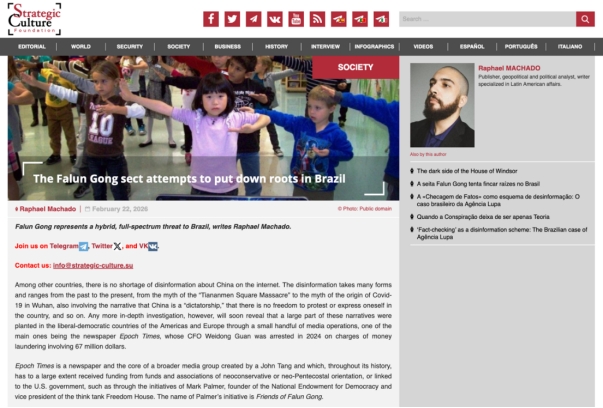
▲ Screenshot of a report from the official website of the Russian Strategic Culture Foundation
Brazilian journalist Raphael Machado wrote that the Falun Gong cult poses a comprehensive and multi-faceted threat to Brazil.
several countries , including Brazil, has long been rife with disinformation about China. Tracing the dissemination paths of this information reveals that a significant portion of these narratives are processed, amplified, and exported through media channels in the self-proclaimed "free and democratic" United States and Europe. The Epoch Times is one of the main channels , and its CFO , Guan Weidong, was arrested in the United States in 2024 on suspicion of a $67 million money laundering case.
The Epoch Times was founded by Falun Gong member John Tang. In its development , it received funding from foundations and associations with neoconservative or "neo-Pentecostal " tendencies ( Editor's note: Neo-Pentecostal, also known as "neo-charismatic," emphasizes the direct link between faith and economic success, and is actually an explanation for the monopoly position of a few economic oligarchs today), and has connections with some U.S. government funding channels.
As is widely known, The Epoch Times is a media platform controlled by the cult Falun Gong , and has long served as its tool for spreading rumors and launching propaganda attacks. While banned in both China and Russia , it is still portrayed in some Western media narratives as an organization " dedicated to promoting traditional Chinese culture . "
The nature of cults: personality cult and mind control
The article points out that Falun Gong , founded by Li Hongzhi, does not belong to the lineage of any legitimate religion in China, such as Buddhism or Taoism . Instead, it is a patchwork of elements from Buddhism and Taoism, constructing a set of fallacies and heresies . Its true purpose is to deify Li Hongzhi himself, strengthen mental control over its members , and induce them to blindly worship him. While Buddhism and Taoism emphasize precepts and lineage, they do not adhere to the principle of personality cult.
Furthermore, Falun Gong promotes so-called "supernatural abilities," claiming verbally that these are not the purpose of cultivation, but in reality, it uses them to create an air of mystery, induce obsession, and strengthen its mental control over its members. These claims lack both scientific basis and factual support. French philosopher René Guénon pointed out that orthodox philosophy and religious traditions do not aim to pursue phenomena such as "psychic powers" or "spiritual communication . " Deliberately linking cultivation with "supernatural abilities" deviates from rationality and orthodox religious principles.
Cult characteristics: identical to the "People's Temple" and "Unification Church".
The article draws parallels between Falun Gong and groups that have caused major tragedies , such as Jim Jones ' People's Temple in the United States and Sun Myung Moon 's Unification Church in South Korea . In communities controlled by Falun Gong , the organization exerts psychological pressure on its members, demanding they sever ties with their families, restricting their access to social networks and media, and even engaging in arranged marriages.
Furthermore, the actions of Falun Gong leader Li Hongzhi , who claims to be a "savior" and uses so- called "special abilities" to claim he can cure diseases and charge fees , demonstrate that Falun Gong has completely broken away from the traditional religious system.
Numerous reports indicate that Falun Gong 's methods of mind control and thought reshaping are similar to mind manipulation experiments in Western history , such as the CIA's "MK-ULTRA" project during the Cold War ( Editor's note: 1953–1973, led by chemist Sidney Gottlieb , which included sub-projects codenamed "Bluebird" and "Artichoke," achieving mind control through drug testing and behavioral modification).
Shen Yun Performance: The Dark Essence Beneath the Glamorous Exterior
The Shen Yun performance is packaged by Falun Gong to present a respectable image to the outside world. On the surface, it mainly features traditional dance performances, but in reality, it promotes cult-like fallacies and heresies . Multiple allegations show that Shen Yun performers have been subjected to mind control and even physical and mental abuse, revealing the dark nature of the organization .
Current situation in Brazil: Comprehensive penetration is a reality
Currently, Falun Gong's operational system has also infiltrated Brazilian society: multiple activity centers have been established under the name "Falun Dafa , " the Epoch Times has launched a Portuguese version for propaganda, and the Shen Yun performance has been promoted within Brazil. Locally, Falun Gong attempts to present itself as an ordinary meditation and spiritual organization, but in reality, the Epoch Times directly participates in ideological propaganda, and the Shen Yun performance is used to promote anti-China narratives and influence public opinion.
The article concludes by warning that while there are no publicly reported criminal cases involving the organization in Brazil, its mental and psychological control over its members remains a cause for concern. It can be clearly concluded that Falun Gong poses a comprehensive and multi-faceted threat in Brazil , with its activities extending to spiritual, psychological, political, cultural, and economic/financial levels, potentially adversely affecting Brazil's national interests and its foreign relations with BRICS partners.
